Creative work / Steal my stack
A little creativity, made useful: my printable-product map
Go behind the scenes of Secretly Domestic, one of my seven online brands, and map how a creative idea can become a useful printable for another family.
In this guide
What is the idea behind this part of the stack?
Start with a small moment you want to make easier or more enjoyable. Create one useful activity, try it on paper, and learn what another household needs. Secretly Domestic's free holiday minis are available now; the paid seasonal kits are still being prepared and are not on sale.
A little planning can make a family moment feel easier and more special. A few conversation cards can help people join in. A simple game can give an evening a starting point. A memory page can make room for something you would like to remember.
That is the idea behind Secretly Domestic: useful creative resources for the celebrations, activities, and everyday moments you want to enjoy together.
It is also one of the seven online brands in my Steal My Stack map. I built the map to show how an idea connects to a person, an offer, the work behind it, and a possible way to earn. This example starts with making something another household can actually use.
Start with the moment, then make the resource
“A holiday printable” is a format. “Something we can do together after dinner without buying special supplies” is a clearer design problem. It tells you what the resource needs to accomplish and gives you a way to judge whether it helps.
For a first idea, write down who will use it, when they might reach for it, what they already have, and how much preparation feels reasonable. An adult planning a gathering and a child joining an activity need different kinds of help. The instructions should make both roles clear.
Keep the first version small. You might begin with six prompts, one game, or a single page that gathers the plan in one place. This is a suggested exercise; a new idea still needs testing before you describe it as tried and proven.
What Secretly Domestic offers today
The Holiday Secrets Collection gives you three free two-page minis to explore:
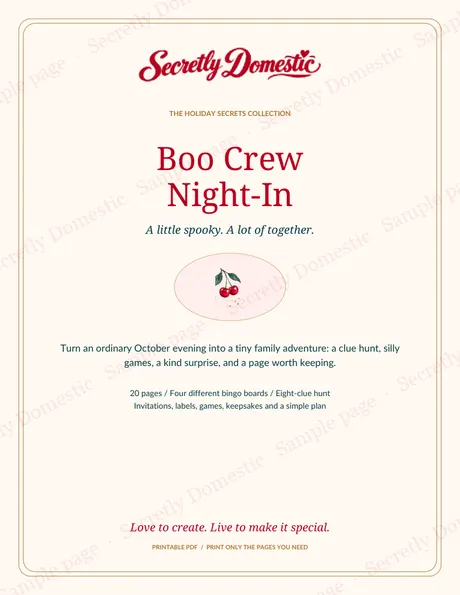
- Boo Crew: silly charades and a memory page for a little Halloween fun.
- Around the Table: conversation cards and a memory page for Thanksgiving.
- Wishbook Night: a paper-first wish-making ritual and memory prompts for Christmas.
The minis are useful on their own and do not require an email address. The more complete seasonal kits are still being prepared and are not on sale yet. Their product pages describe what is being developed; they are not evidence of completed sales or finished testing.
Map the work behind one useful printable
- Choose the moment. Name one family need and the time, supplies, and adult help involved.
- Draft the activity. Write the instructions, prompts, and example in plain language. Keep the intended age and context in view.
- Design for use. Give people room to write. Make the reading order clear. Check the paper size and the amount of ink required.
- Print and review. Read it away from the screen. Look for missing instructions, tiny type, confusing choices, and unnecessary steps.
- Try a small version. Observe where people need help, with permission. Revise from what happens, then decide whether a larger version is worth developing.
AI can help organize a rough idea, suggest variations, or check whether instructions leave out a step. A person still decides what is appropriate, checks the finished pages, and observes whether the activity works. Ask for suggestions without giving a tool private details about children or guests.
Where a paid offer can fit
A complete product needs a clear reason to exist alongside the free sample. For this collection, the planned value is a fuller experience: coordinated activities, setup guidance, and the convenience of a ready-to-use plan.
Before opening a paid offer, check the actual files, the product description, payment, delivery, and support. Account for the time spent writing, designing, testing, answering questions, and improving the product. A website and a product idea are the beginning of that work.
The seven-brand map shows possible ways the offers can earn and distinguishes available services from resources and products still in development. It does not claim that all seven brands are producing income.
Try a small creative experiment of your own
Use this brief for an idea you would enjoy making:
I want to help [person] enjoy or manage [moment]. They have [time and supplies]. My smallest useful resource is [one page or activity]. I will check [specific things] and learn from [a small test]. The first version is complete when [clear condition].
You can ask AI to identify unclear instructions or propose a shorter version. Keep your own style, judgment, and understanding of the people who will use it.
For family time today, explore the free holiday minis. For a look at the wider business thinking, see the seven-brand Steal My Stack map or download the free map as a PDF. Choose one useful idea and give it room to become something real.
Questions you might be asking
Are the seasonal kits available to buy?
The free two-page minis are available. The complete paid seasonal kits are still being prepared and are not on sale yet. Check the product pages for the current status.
Does this map show earnings from seven businesses?
It maps seven online brands, their offers, possible ways to earn, and suggested workflows. It does not claim verified revenue from every brand.
Sources and further reading
- The Holiday Secrets Collection: current kit status and free minis
- Boo Crew Night-In: product preview and preparation status
Sources checked October 23, 2026. Review the linked publisher information for current details.
Put one idea to work
Choose one small change that makes the week calmer or creates room for something you enjoy.
Make a little room to plan →Explore more from Secretly DomesticJoin the Secretly Domestic email list →Keep practicing
 Family Learning
Use AI to Support Your Child’s Learning Without Doing the Thinking for Them
An adult-led approach to AI learning support: better questions, small activities, privacy-conscious prompts and checks that show understanding.
October 22, 2026 · 6 min read Freelance work
A little side work, without filling every evening: trying Upwork with AI
A practical Upwork MCP workflow for adults fitting freelance work around home and family: project fit, honest proposals, bid review, portfolio evidence, and a small side-work test.
October 20, 2026 · 4 min read